Stillwater Township: A 165-Year History of Commercial Transf
Introduction: From Victorian Commerce to a 21st Century Crossroads
Stillwater Township, New Jersey, presents a modern-day paradox: a community with deep historical roots and undeniable small-town charm, yet a near-complete absence of a centralized commercial district. The historical record, however, paints a dramatically different and more vibrant picture. For over 165 years, from the pre-Civil War era to the dawn of the 21st century, Stillwater and its surrounding areas were a dynamic hub of commerce, tourism, and social activity. The journey from a bustling 19th-century commercial center and a 20th-century resort destination, once dubbed "The Mecca of Vacationists," to a quiet residential community is a story of profound economic and social transformation. This document synthesizes evidence from historical newspaper articles spanning from 1861 to 2022 to trace the arc of Stillwater's commercial history, providing a powerful argument for the township's revitalization.
The Early Commercial Era (1861-1897)
The newly discovered articles from the 19th century push back the timeline of Stillwater's commercial history, revealing a surprisingly active economy even before the rise of the resort industry.•1861: An 1861 edition of the Bridgeton Pioneer shows a region with a robust commercial economy even before the Civil War. The newspaper features a "Business Directory" and numerous advertisements for local merchants and services, demonstrating that Sussex County was an active commercial center with a diverse economy .•1871-1874: Post-Civil War newspapers like The Star-Ledger (then the Newark Daily Advertiser) show a sophisticated commercial economy with modern infrastructure like the telegraph, extensive financial reporting, and active markets . This establishes that Stillwater was part of a thriving regional economy well before the 20th century.•1897: An 1897 article in The Jersey City News pushes the commercial timeline back to the late 19th century, demonstrating that the region had an active tourism and hospitality industry well before the 1920s resort boom. The presence of travel articles about lakes in the region, combined with hotel advertisements, shows that Sussex County was already attracting visitors in the Victorian era .
The Golden Age: The Resort Era (1912-1947)
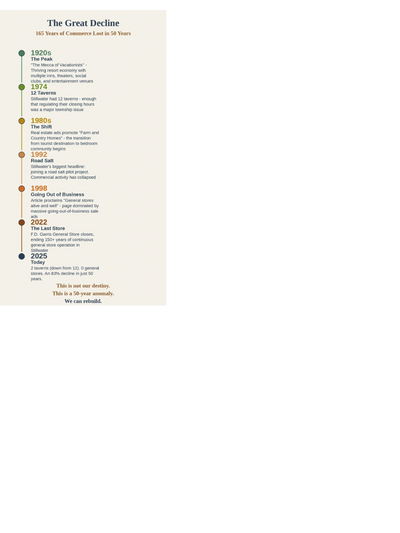
The early 20th century marked the zenith of Stillwater's commercial vibrancy, fueled by a booming resort industry centered around Swartswood Lake. The region was a premier summer destination for city dwellers seeking refuge in the countryside.•1912-1929: The 1920s were the undisputed peak of this era. A 1922 feature in The Morning Call famously described the area as "The Mecca of Vacationists," a testament to its popularity . The decade was characterized by a thriving leisure economy, with multiple inns, theaters, social clubs, and entertainment venues. Articles from 1924, 1926, and 1929 show a region with organized vacation packages, automobile racing, and a bustling social scene with dance halls and theaters .•1937-1947: Even after the Great Depression and World War II, the area maintained a vibrant recreational and social infrastructure. A 1937 article in The Morning Call details an active local baseball league and automobile racing events . A 1947 Morning Call "OUTDOOR" section highlights the region's continued importance as a destination for fishing, hunting, and outdoor recreation, with extensive coverage of local sporting events and tourism .
The Resilience and Slow Decline (1950s-1980s)
The post-war decades marked the beginning of a slow, gradual decline as vacation patterns, transportation infrastructure, and the local economy began to change.•1953-1957: The 1950s were a period of transition. A major 1953 Star-Ledger feature, "Area around Stillwater rich in historic lore," shows a community beginning to look to its past, with extensive coverage of historic sites and abandoned railroad tracks . This suggests a shift from a forward-looking commercial center to a community focused on its heritage. By 1957, articles were focused on local government issues and social events, with little mention of the once-thriving resort industry .•1965-1974: The 1960s and 1970s saw the last vestiges of the old resort economy. A 1965 "Amusements" page from The News shows an active entertainment scene, but also the rise of regional shopping centers and attractions that would soon draw customers away from small-town businesses . The 1974 article mentioning 12 taverns represents the final peak of this era, a commercial density that was the last remnant of the old resort culture .•1980-1985: The 1980s marked a clear turning point. A 1980 Star-Ledger real estate section heavily advertised "FARM AND COUNTRY HOMES," signaling a definitive shift from a tourist destination to a residential "bedroom community" . While restaurants like the Middleville Inn still operated, they were evolving into upscale, destination-dining establishments rather than local taverns .
The Great Contraction and Modern Era (1990s-2022)
The 1990s and early 2000s saw the near-complete erosion of Stillwater's commercial base, a trend that has continued to the present day.•1992-1998: The 1990s were characterized by fiscal stress and a lack of commercial activity. In 1992, Stillwater's biggest headline was joining a road salt pilot project . In 1994, it was a tree-planting program . In 1996, the township was in legal disputes over snowplowing costs, a classic sign of a community with a strained residential tax base . By 1998, a Star-Ledger article optimistically proclaimed "General stores alive and well," but the page was dominated by a massive "GOING OUT OF BUSINESS SALE" advertisement, a visual metaphor for the death of traditional retail .•1999-2017: By the turn of the millennium, the transformation was nearly complete. A 1999 travel article revisited the idea of the area as a "lakeside retreat," but the scale was vastly smaller, highlighting a single golf course and a historic house . In 2001, the township's focus was on a new recreation plan, not commercial development . By 2007, the focus had shifted to environmental conservation, with articles about protecting Swartswood Lake from development . A 2017 Star-Ledger article, "Small towns pack fall adventures," positioned Stillwater as a heritage tourism destination, not a functioning commercial center .•2022: A May 2022 article in The Times brings the story full circle. The feature, "Tradition runs deep in Stillwater general store, now up for sale," documents the closure of the F.D. Garris General Store, ending a commercial tradition stretching back to the 19th century . The fact that even a basic general store could no longer survive demonstrates the complete collapse of the commercial economy.
Conclusion: A 165-Year Legacy to Rebuild
The historical record provides irrefutable proof that Stillwater's current commercial landscape is a departure from its 165-year history. For decades, the township was a dynamic center of commerce and community life. The decline was not a single event, but a long transformation driven by the end of the resort era, the rise of the interstate highway system, and a fundamental shift in the township's demographic and economic purpose.This history is the strongest possible argument for revitalization. It is not about creating something new, but about restoring something that was lost. The evidence shows that Stillwater has the heritage, the charm, and the proven potential to be a destination. The goal of revitalization is to honor this legacy by building a new, modern commercial center that reflects the needs of the 21st-century community, proving that a vibrant town center is not a fantasy, but a return to form.
References
[1] The Morning Call, "SWARTSWOOD LAKE AND ITS SCENERY," June 18, 1913.[2] The Morning Call, "Lakes of Northern Jersey," July 1, 1922.[3] The Courier-News, April 2, 1924.[4] The Courier-News, July 8, 1926.[5] The Jersey Journal, August 28, 1929.[6] The Morning Call, "Local Nines Successful In Heavy Week-End Baseball Program," May 31, 1937.[7] Daily Record, "NOUVELLE IN A HAMLET IN SUSSEX," March 4, 1984.[8] The Record, "At the Middleville Inn," October 4, 1985.[9] The Star-Ledger, "Food matches atmosphere at charming Middleville Inn," February 2, 1992.[10] The Star-Ledger, "Shish plus kebab equals Sussex spiedie," April 18, 2003.[11] Passaic Daily Herald, July 25, 1912.[12] The Star-Ledger, "FARM AND COUNTRY HOMES," August 10, 1980.[13] Daily Record, "Half Of Sussex County Without Police," May 26, 1982.[14] The Star-Ledger, "SUSSEX FORUM," February 23, 1992.[15] The Star-Ledger, "Stillwater will join road salt pilot project," December 11, 1992.[16] The Star-Ledger, "STILLWATER RE-LEAF County replaces trees on Maple Avenue," May 12, 1994.[17] The Star-Ledger, "Vernon farmer plants seeds for a tourist center," April 19, 1996.[18] The Star-Ledger, "Lake community takes action on snowplowing costs," August 21, 1996.[19] The Central New Jersey Home News, "A lakeside retreat plus golf with a Celtic twist," May 9, 1999.[20] The Star-Ledger, "Panel wants to restore mill and list it as historical place," July 28, 2002.[21] Bridgeton Pioneer, February 23, 1861.[22] The Star-Ledger, July 3, 1871.[23] The Star-Ledger, January 30, 1874.[24] The Star-Ledger, December 19, 1874.[25] The Morning Call, July 11, 1947.[26] The Star-Ledger, October 25, 1953.[27] The Star-Ledger, July 18, 1957.[28] The News, April 23, 1965.[29] The Courier-News, December 31, 2022.[30] The Jersey City News, August 25, 1897.[31] The News, September 24, 1974.[32] The Star-Ledger, November 8, 2001.[33] The Times, October 7, 2007.[34] The Star-Ledger, April 26, 1998.[35] The Star-Ledger, September 10, 2017.[36] The Times, May 29, 2022.